VIPR - Versatile Framework for Inverse Problems
The Problem: Reconstruction of hidden material properties from complex measurement data
Working with the neutron reflectometer creates a physically demanding inverse problem: from noisy reflectivity measurement data, central material properties such as layer thickness, roughness, or density profiles must be reconstructed. Together with MLZ Instrument Scientist Dr. Alexandros Koutsiumpas, the entire measurement and analysis process was examined. The challenge is to read the machine's data almost in real-time, automatically select the appropriate pre-trained model from metadata, and reliably feed the analysis results back into the experimental workflow – for example, for in-situ machine control. At the same time, the results should be visualized in an understandable and user-friendly way via a frontend.

The Solution Approach: Invertible neural networks for fast and robust reconstructions
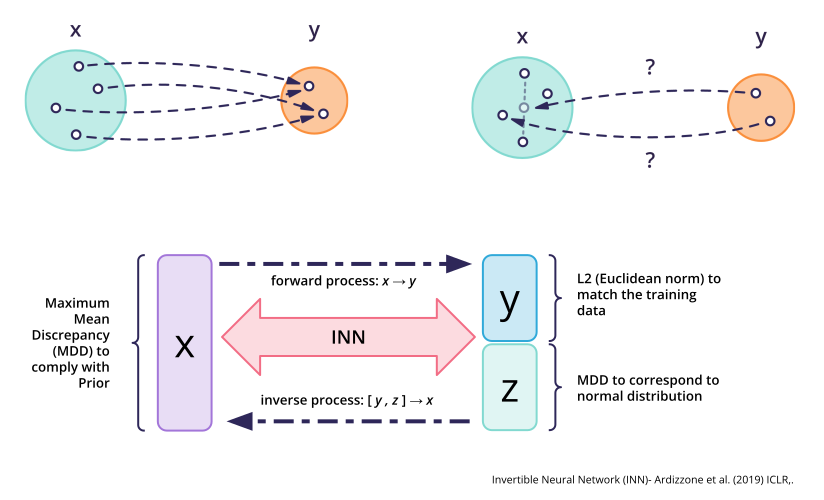
An invertible neural network enables direct solution of the inverse problem: it learns the mapping between measurement data and material properties in a way that this relationship remains unique and reversible. This allows the model to directly infer the underlying material parameters from noisy reflectivity curves – without time-consuming iterative simulations. Through automated selection of a suitable, pre-trained model, new measurement data can be analyzed immediately, while the web interface allows even non-specialists to intuitively experiment with different models and compare their results.
Analysis and visualisation in the research workflow
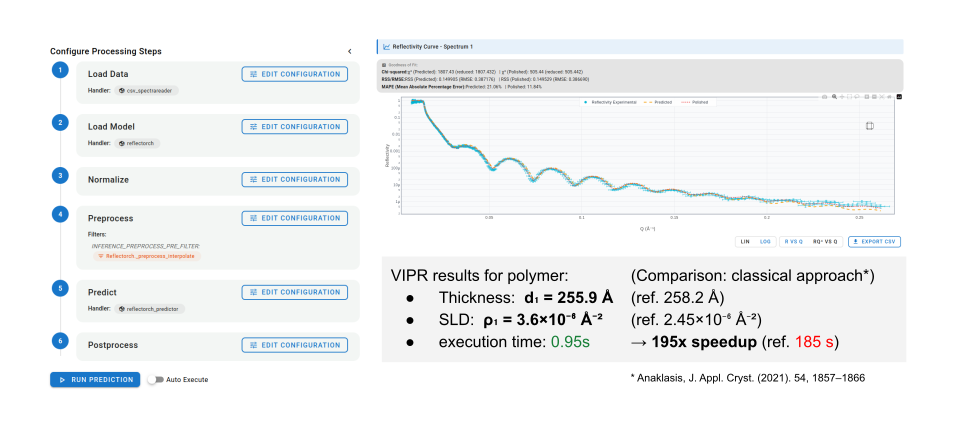
The VIPR framework combines model-based measurement analysis with a web interface for configuration and visualisation. The example interface displays a calculated reflectivity curve and reconstructed material parameters. Analysis speed in an experiment depends on factors including the model, data and computing environment; the example does not establish a general runtime or real-time guarantee.